
July 19, 2026
Please Don’t Cheat: AI Gameplay Cheater Detector
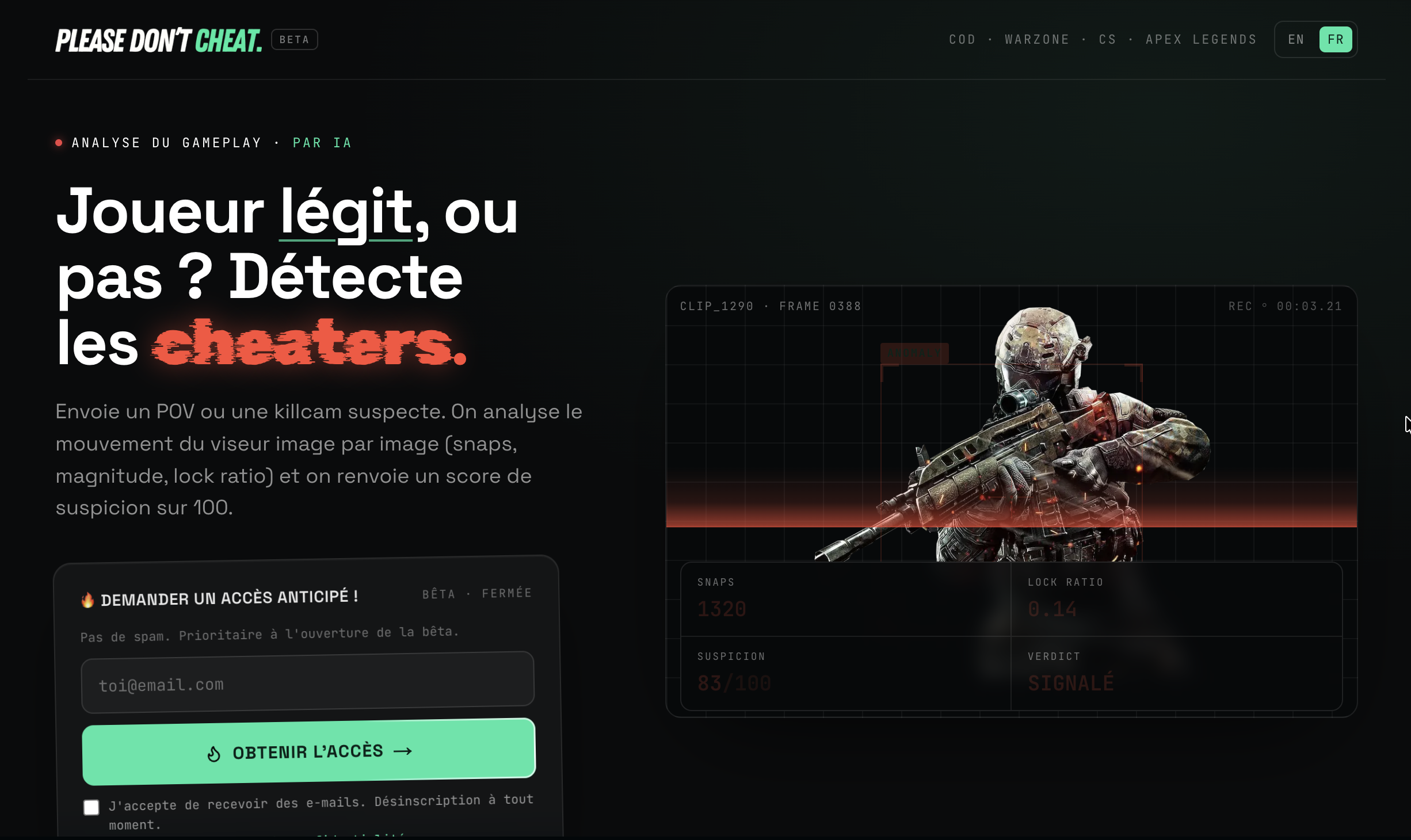
I’m Building an AI Gameplay Cheater Detector We have all watched that one killcam. The crosshair snaps straight onto a player. The tracking looks almost too clean. The movement feels strange, but nobody in the lobby can agree on what actually happened. One player calls it cheating. Another says it was just a lucky shot. That is exactly why I started building Please Don’t Cheat, an AI-powered gameplay analysis tool designed to examine suspicious POVs and killcams more objectively. Instead of relying only on instinct, rage, or slow-motion replays, the app studies crosshair movement frame by frame and looks for measurable aiming patterns.
How does the gameplay analysis work?
The workflow is deliberately simple.
First, you submit a short clip showing a suspicious gunfight. It can be a killcam, a player POV, or another gameplay sequence where the aiming behavior looks unusual.
The system then examines the footage frame by frame. It measures signals such as crosshair snaps, tracking movement, aiming magnitude and lock ratio.
Finally, the app produces a suspicion score out of 100, along with a verdict indicating whether the sequence appears legitimate, suspicious, or requires further review.
The goal is not to declare someone guilty based on a single clip. The goal is to replace vague accusations with measurable information.
Built for competitive FPS games
Please Don’t Cheat is being designed around competitive shooters such as:
Call of Duty
Warzone
Counter-Strike
Apex Legends
These games are full of fast movements, aim assists, high-level players and unusual camera behavior. That makes reliable analysis difficult, but also makes objective data far more useful than another argument in the game chat.
This is not an official anti-cheat
Please Don’t Cheat is not intended to replace the anti-cheat systems built into games.
It cannot access a player’s computer, inspect installed software or prove that cheats were running. It analyzes only the visible behavior contained in the submitted video.
That means the result should be treated as an objective estimate, not a final conviction.
Why I’m building it
Most cheating discussions begin and end with:
“That looked suspicious.”
I want to see whether computer vision and movement analysis can make those conversations more useful.
Can we identify aiming patterns that appear repeatedly in suspicious clips? Can we compare legitimate high-level players with obvious anomalies? Can we create a score that is understandable and reproducible?
That is what I am currently testing.
Please Don’t Cheat is still in beta, and early access will be opened progressively as the analysis becomes more reliable.
Want to test a suspicious clip?
Join the early-access list and keep your best suspicious killcams ready.
Legit player or cheater?
Let’s look at the data.